AI voice cloning technology has opened new pathways for scammers to target emotionally vulnerable families. Through the ‘Hey Mom’ scam, fraudsters use AI to mimic loved ones’ voices, inducing panic and pressing for hasty decisions. This piece describes how the technology works, its impact, and the preventive steps families can take. From understanding the mechanics behind voice cloning scams to recognizing the chilling effect they have on financial and emotional well-being, each chapter provides insights and actionable advice. As threats evolve, cultivating awareness and robust defenses is paramount for safeguarding loved ones from becoming victims.
Panic and Profit: How Emotional Manipulation Fuels the ‘Hey Mom’ Scam

AI voice cloning is revolutionizing the landscape of fraud by tapping into the most vulnerable aspect of human interaction: emotional manipulation. The “Hey Mom” scam epitomizes this approach by exploiting familial bonds, inducing panic in victims who believe a loved one is in imminent danger. Scammers craft terrifying scenarios, such as a child being involved in an accident or under arrest, to prompt immediate, unthinking responses from targeted family members.
The mechanism behind these scams is deceptively simple yet devastatingly effective. Scammers often start with audio clips of less than a few seconds, typically sourced from social media or public platforms. By feeding these clips into sophisticated AI voice cloning software, they generate convincing replications of voices familiar to the victim. Such manipulations have become so precise that victims, caught off guard by cries of distress, rarely pause to examine the veracity of these claims.
Key strategies in these scams hinge on creating a sense of urgency. Scammers request money transfers or sensitive information while urging secrecy, all under the guise of a familial crisis. By asking victims not to disclose the call to others, scammers isolate targets from potential voices of reason, increasing the chances of compliance without verification. Despite the increasing realism of AI-generated voices, slight irregularities do appear—such as minor robotic tones or unnatural pauses—which could serve as red flags if the victim is not overwhelmed by fear.
Financially, victims can suffer significant losses, with reports of people losing from $5,000 to $100,000 in a single incident. Protecting oneself from such scams involves proactive measures: establishing a family “safe word” can serve as a simple yet effective verification tool. Moreover, a skeptical approach to urgent financial requests and careful listening for vocal irregularities are advised. Unfortunately, the advancement of AI ensures these attacks are only becoming more sophisticated, so continuous awareness and prepared strategies are critical defenses families must maintain.
Inside the Tech: How AI Voice Cloning Fuels the ‘Hey Mom’ Scam

Artificial intelligence’s rapid advancement has paved the way for sophisticated voice cloning technologies, now being used in unsettling ways to exploit families. Central to the unsettling ‘Hey Mom’ scam, these AI-driven tools masterfully mimic the voices of loved ones, crafting a credible illusion that’s hard to distinguish from reality.
The primary step in this technology is the collection of audio samples. Scammers exploit social media, voicemails, and various public recordings to obtain brief audio snippets of their target, often requiring as little as thirty seconds of speech. This initial step is surprisingly easy in our digital era where personal content is frequently available online.
Once collected, these audio samples feed into state-of-the-art machine learning models. Tools like WaveNet and Tacotron, or even accessible open-source software, analyze the unique vocal qualities of an individual. These algorithms meticulously recreate pitch, tone, and rhythm, producing a voice clone that’s eerily accurate. The sophistication of these models means that the synthetic voices they generate are virtually indistinguishable from their real counterparts. This capability significantly enhances the scam’s efficacy, as it closely replicates their speech for both live interactions and pre-recorded messages.
In the fraudulent execution, scammers simulate emergencies with frightening realism. Impersonating children in distress, they can bypass traditional safeguards by exploiting familial bonds—instantly triggering parental instincts to protect. Coupled with personalized details, often scraped from the target’s online presence, the scammer’s narrative becomes increasingly convincing. This seamless blend of technology and psychological manipulation can immobilize families with fear, driving them to comply without a second thought.
The accessibility of these tools is alarming. Criminals no longer need extensive resources to initiate these scams; free or inexpensive software makes it disturbingly easy to execute. Detection also poses a critical challenge. Given their ability to create accurate voice replicas in mere minutes, these tools compromise our trust in voice confirmation. The rise of such technology demands an urgent rethink of how we protect personal audio content and verify identities. As these tools become commonplace, staying informed and verifying through alternative channels becomes imperative to safeguarding emotional and financial security.
For steps on enhancing your digital security, visit our recommended cybersecurity practices.
Emotional Fallout and Financial Toll: The Dual Impact of AI Voice Cloning Scams on Families

When a comforting, familiar voice rings in the middle of a busy day or late at night, it typically brings assurance. Yet, the sinister “Hey Mom” scam uses this familiarity as a weapon, wreaking havoc on emotional and financial stability. This type of social engineering fraud cleverly exploits the unsuspecting, sowing seeds of panic while targeting the wallets and hearts of families.
The financial ramifications are immediate and often irreversible. Victims, disoriented by an urgent plea from a voice they trust, are coerced into transferring funds—often in unconventional forms like cryptocurrency or gift cards, which complicates recovery efforts. According to the FTC, such incidents frequently result in median direct financial losses between $3,000 and $5,000, sometimes going even higher. Beyond the immediate cash drain, victims may incur further costs through interest on hastily acquired loans or bank fees.
Beyond the tangible loss of money, the psychological damage inflicted can be profound. It starts with an overwhelming wave of shock and helplessness, particularly as these scams target the protective instincts that parents naturally harbor. Consequently, many suffer prolonged guilt and shame, compounded by a newfound skepticism towards technology and personal communications. The intimacy of these attacks—emanating from a synthesized voice—can permanently alter one’s sense of security.
These incidents ripple through familial relationships, often causing strain and distrust among family members. The targeted individuals, overcome with embarrassment, may become defensive or isolated, feeling judgment from those who were indirectly affected by their decision to act quickly. In some cases, this leads to an excessively cautious attitude, where fear overrides the willingness to respond to genuine calls for help. As a result, the ongoing anxiety can severely restrict a victim’s digital interactions and affect their willingness to engage openly and without fear.
Addressing the layers of impact left by the “Hey Mom” scam requires not just awareness but also accessible support systems. Families are encouraged to strengthen their defenses with protective strategies that maintain digital trust without paralyzing their instinct to help family in need. These developments underscore the importance of resilience, community support, and continuous education in safeguarding the emotional and financial well-being of families against evolving AI threats. For further insights on protecting against similar technological threats, consider exploring proactive strategies in IT support.
Guarding Against the ‘Hey Mom’ Scam: Empowering Families with Proactive Defense Tactics

In an era where artificial intelligence blurs the lines between reality and deception, protecting families from the “Hey Mom” scam requires a blend of strategic foresight and practical actions. At the heart of these strategies lies the importance of family unity through a shared code word. This simple, yet powerful tool serves as the first line of defense, offering an easy verification method that scammers, regardless of their technological prowess, cannot easily breach.
Another crucial tactic is the reliance on verification through separate channels. When faced with a phone call that raises suspicion, it becomes vital to independently confirm the caller’s authenticity. This could mean quickly contacting the supposed caller through their known number, or cross-verifying with other family members to ensure the situation is genuine. Such actions, although they require a momentary pause, can thwart any immediate scam threats.
Moreover, it’s imperative to maintain a healthy skepticism towards caller ID displays, which can be easily spoofed by savvy criminals. Instead of trusting the number that appears, individuals should focus on corroborating identities through more reliable means. In parallel, limiting public access to personal audio recordings can significantly lower the opportunities for voice cloning. Social media platforms, while offering connectivity, also provide a treasure trove of material that can be exploited for cloning if not carefully managed.
Technological innovations also offer support in this defensive arsenal. Tools like VoiceSecure can disrupt AI voice analysis, thereby preserving conversation confidentiality. Implementing multi-factor authentication adds a safety net to voice-authenticated applications, ensuring they are not solely reliant on potentially compromised voice data.
Awareness serves as the final keystone. Regularly educating family members about voice scam tactics enhances collective vigilance. Reducing one’s digital footprint—by locking down social media profiles and being mindful of the information shared online—further mitigates risks. As AI tools become more sophisticated (see 5 Cybersecurity Habits Every Small Business Must Adopt), staying informed and adaptable remains essential for safeguarding familial emotional security in the digital age.
AI’s Deceptive Evolution: Navigating the Next Generation of Voice Cloning Scams
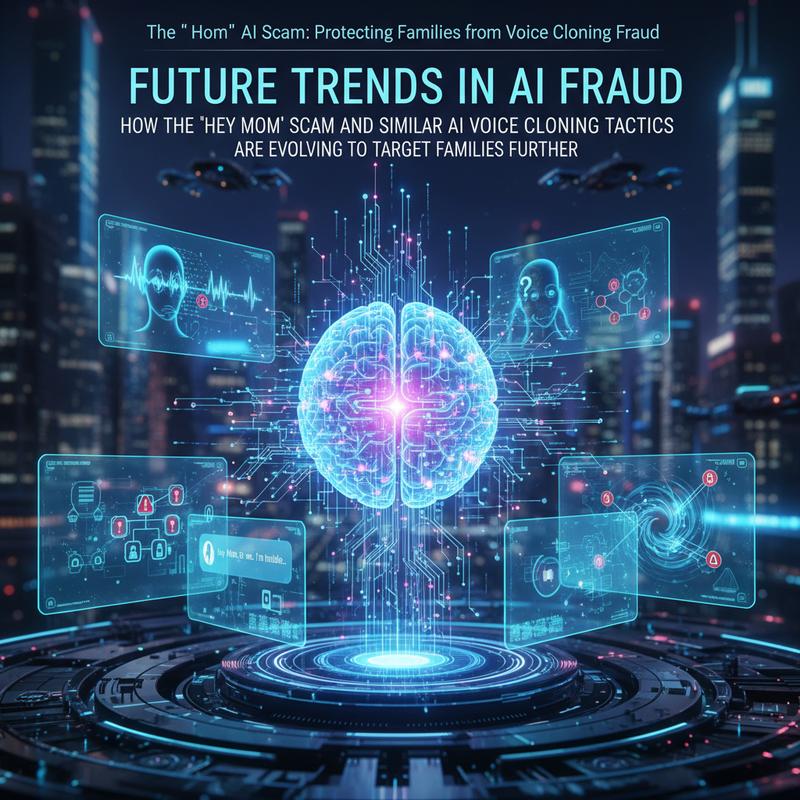
AI-driven voice cloning fraud, especially tactics like the “Hey Mom” scam, is advancing at a concerning pace. Once reliant merely on recordings, modern scams can create hyper-realistic voice clones from just a few seconds of audio. This precision in mimicking pitch, tone, and emotion poses substantial risks, making it increasingly difficult for victims to distinguish between authentic and fraudulent voices. The rapid evolution of this technology allows scammers to initiate real-time, interactive dialogues, elevating the threat by delivering more authentic impersonations during phone or video calls.
As these deceptions unfold, perpetrators frequently blend voice cloning with other AI technologies like deepfakes and phishing to conduct multi-channel attacks. Victims may be approached via combinations of phone calls, texts, and emails, each layer amplifying the manipulation. Scammers exploit the vulnerable, specifically targeting seniors, whose emotional triggers can be effortlessly manipulated by crafting scenarios involving distressed grandchildren or family emergencies.
The commoditization of these tools further aggravates the situation. Accessible through online markets, they require minimal expertise, democratizing fraud activities to petty criminals. This accessibility prompts an alarming trend where automated target profiling becomes routine. Through advanced data analysis, scammers can prepare personalized attacks, deeply exploiting familial relationships and recent events.
Conventional security measures, such as caller ID and basic verification questions, are proving inadequate against these sophisticated scams. Voice-based authentication systems are particularly susceptible, raising calls for families to implement new strategies. Shared code words within families can serve as critical safeguards, while minimizing public sharing of voice data becomes an essential preventative step.
Ongoing public awareness campaigns are paramount as nearly half of adults remain unaware of the existence or realism of these scams. Education and vigilance are critical as society grapples with the full spectrum of AI’s influence on digital trust and emotional security. To stay informed about AI safety and emerging technologies, it’s beneficial to review resources like those discussed on IT Carolina’s blog, which provides insights into protecting digital identities in an evolving technological landscape.
Final thoughts
The ‘Hey Mom’ scam represents a disturbing intersection of technology and emotional manipulation, exploiting familial trust. Awareness and preventive measures are vital to mitigating its impact. By understanding the technology behind AI voice scams and adopting verified security practices, families stand a better chance against these threats. Evolving awareness and defense mechanisms can help safeguard both financial standing and emotional well-being, key to resilience against these intrusions into family security.
Protect your family from AI voice scams—get expert help securing your home technology today.
Learn more: https://itcarolina.com/about/
About us
As AI-powered voice cloning scams like the ‘Hey Mom’ fraud become more common, IT Carolina offers the trusted, on-site tech support you need to safeguard your household. Our experts not only optimize your gaming and entertainment systems, but also help secure your smart home devices and communication tools against the latest threats. Whether it’s configuring safer call settings, advising on privacy-focused tech, or enhancing your home network’s security, IT Carolina delivers peace of mind through personalized, hands-on service—so you and your family can enjoy your technology without worry.