Portable chargers and power banks are basically must-haves for travelers and commuters who need their phones (and everything else) to stay on. In 2026, they’re packed with smarter features and more user-friendly designs for different kinds of people. You’ll see things like magnetic wireless charging, USB-C Power Delivery, bigger-capacity options, and built-in cables, so there’s a lot to pick from. This guide breaks down the features that actually make a difference, shares top picks for common charging situations, helps you choose the right mix of capacity and speed, and covers what to look for so you don’t get lost in all the 2026 options. By the end, you’ll know what to buy so you can stay charged and head out without stressing about your battery.
Advanced Features in 2026 Portable Chargers and Power Banks
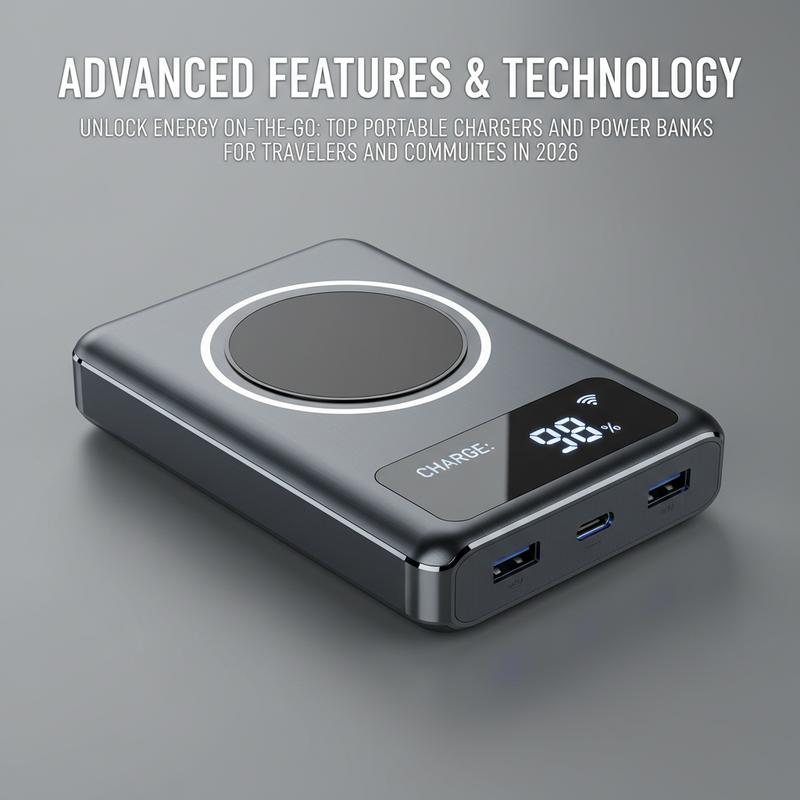
Portable chargers have come a long way, and 2026 models bring a bunch of useful features and tech that match how people actually use their devices. The big ones are built-in cables, wireless charging, smarter screens, app support, and faster charging. And yeah, each one fixes a real annoyance, like forgetting a cable or not knowing how much power you have left.
Integrated cables and connectors are now one of those features you don’t miss until you don’t have it. You’re carrying a power bank anyway, so having the cable attached means one less thing to remember. Models like the Belkin Boostcharge do this with built-in cable setups, which solves the classic problem of having power but no way to plug in. Anker’s 10K Fusion takes it further with a built-in USB-C cable plus a foldable plug, so it’s easier to pack and way easier to use on the fly.
Wireless charging keeps getting more popular, and MagSafe compatibility is what most premium models aim for. The Biolite Charge 100 Max includes a good mix of ports and adds wireless pads that work with MagSafe devices, so you can top up without messing with cables. Anker’s Maggo Power Bank uses Qi-certified tech and a strong magnetic hold, which makes wireless charging feel a lot less finicky.
On top of the hardware, a lot of power banks now come with smart display tech. LCD screens on devices like the Anker Maggo Power Bank show live info like remaining battery percentage, estimated time left, and charging status. Thing is, that little bit of detail makes planning way easier, especially when you’re traveling or charging multiple devices.
App connectivity is another newer add-on, with devices like the Anker Prime Power Bank leading the way. With an app, you can monitor things and use extra smart features without guessing. It also helps brands stand out in a crowded market, and it fits right in with how many people already manage gear through apps.
And finally, fast-charging support through Quick Charge (QC) and Power Delivery (PD) is now expected, not a bonus. Anker’s Nano models use these standards to push strong output from small bodies, and newer MagSafe charging options are noticeably faster than older versions.
Put it all together, and you get power banks that are easier to live with day to day, not just bigger batteries in a brick. Now, the trend is clearly moving toward even tighter integration and quicker charging, which should make the next wave even more convenient.
Portable Chargers for Different Needs in 2026
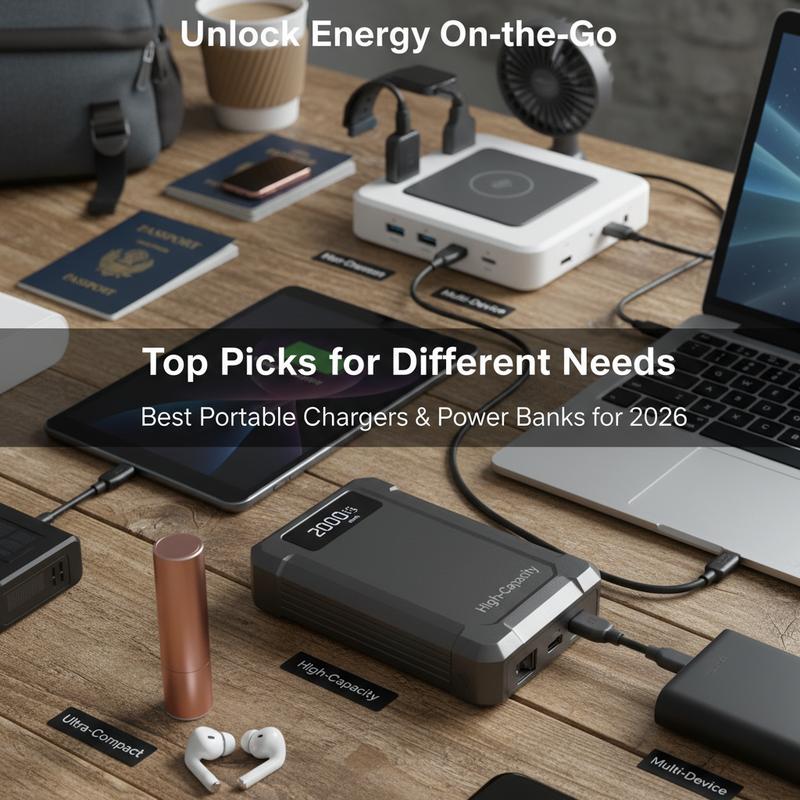
Picking the right portable charger in 2026 really comes down to what you need it for. Are you traveling every week, juggling family devices, or heading outdoors? There’s a model that fits each situation, but the “best” one changes depending on how you’ll use it.
If you travel a lot for work or take long trips, the Anker 25,000 mAh ‘laptop’ power bank is a strong pick. It has enough capacity for several phone charges or a full laptop top-up. With three 100 W USB-C ports, you can charge a laptop, tablet, and phone at the same time and keep moving. It’s a bit heavy at 1.31 pounds, but the built-in cables help cut down the clutter, and the digital display makes it easy to see what you’ve got left. And since it’s airline-approved, it’s the kind of power bank you can actually bring along without hassles.
For shared spaces like homes or offices, the 500 W USB-C charger block is the one that makes life easier. It’s technically a desktop charger, but it often comes up in portable power conversations because it can charge a whole pile of devices from one wall outlet. With 12 ports total (8 USB-C and 4 USB-A), it uses GaN technology to keep charging efficient without turning into a huge box. It also looks clean enough to leave out, which matters when it’s living on a counter or desk. On the flip side, it’s not a battery, but it is a great “everyone plug in here” solution.
If you’re the outdoors type, a high-capacity rugged power bank is hard to skip. These are made for rough use, with impact-resistant shells and weatherproof builds that can handle dust, splashes, and bumps. Many are over 20,000 mAh, which is what you want for multi-day trips when outlets aren’t part of the plan.
And if you just want something small you can carry every day, the iWalk ‘LinkPod’-style power banks are a simple option. They plug straight into your phone and slide easily into a pocket or small bag. With a charger station, you can keep several LinkPods charged and ready, and these 10 W units are great for quick, everyday top-ups.
So, the right pick for 2026 is the one that matches your routine. Big travel battery, shared charging hub, outdoor-ready tank, or tiny plug-in backup—there’s a good fit for each.
Picking the Right Capacity and Speed in 2026
When you’re shopping for portable chargers and power banks in 2026, capacity and charging speed are the two things that decide whether you’ll love what you bought or regret it. And they’re tied directly to what you charge and how long you’re away from an outlet.
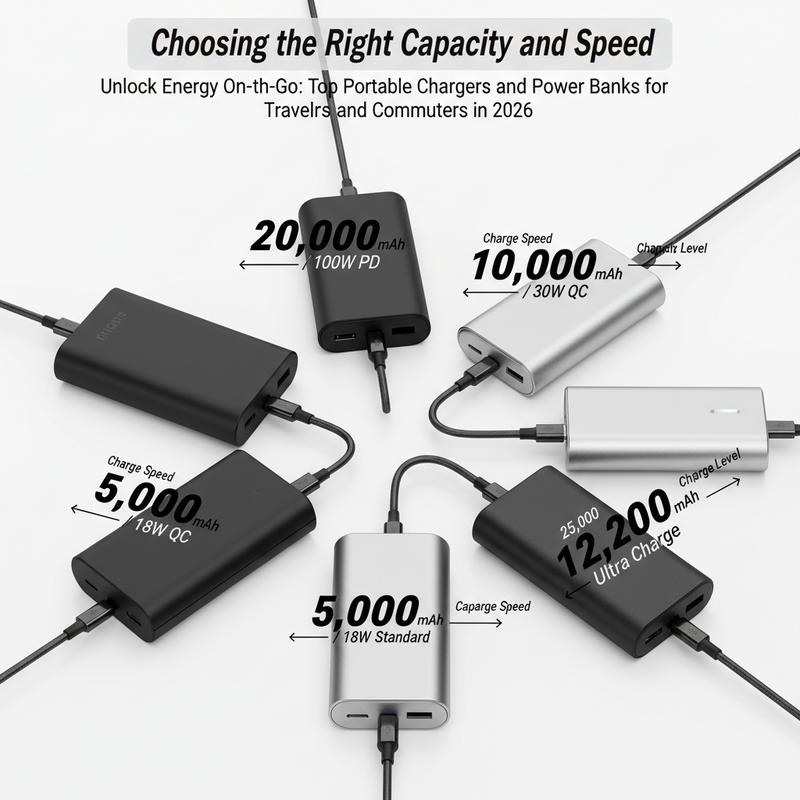
First up: capacity vs. weight. Power banks from 5,000 mAh all the way up to 27,650 mAh all have a place, but not for the same person. If you just want something for emergencies, 5,000 to 6,000 mAh can be enough for a quick save. Step up to 10,000 mAh and you usually get up to two full phone charges, which works well for commutes, day trips, or weekends when you don’t want to carry anything heavy.
For most travelers, the 20,000 mAh range is the sweet spot. You get several phone charges and enough extra to cover a tablet too, which matters on longer trips. Still, these models can stay portable enough to carry around without feeling like a brick in your bag.
If you’re away longer or you’re charging power-hungry devices, going up to 25,000 to 27,650 mAh makes sense. These bigger banks can handle phones, tablets, and even laptops, and they can do it without breaking airline rules, which usually cap power banks at 100 Watt-hours (Wh). It also helps to look at mAh per ounce if you care about pack weight, like when you’re backpacking.
Speed matters just as much. USB-C Power Delivery is now common, and it’s what you want if you care about fast charging. Phones and smaller gadgets typically need 18–30 watts for fast charging. Tablets and lighter laptops often need 45–65 watts. And higher-power devices—like laptops, gaming consoles, or drones—can need 100 watts or more. That’s why matching the power bank’s output to your device isn’t optional if you want charging that’s actually fast.
In the end, getting the balance right means you won’t be stuck hunting for an outlet at the worst time. A good mix of capacity and speed is what makes a portable charger feel like a real backup plan, not just extra weight.
Key Things to Look for in a 2026 Portable Charger
Picking the best portable charger or power bank in 2026 isn’t just about buying the biggest number or the most famous name. The smarter move is to weigh the technical stuff, the everyday usability, and the safety basics so you end up with something that fits your life.
Capacity and Real-World Application
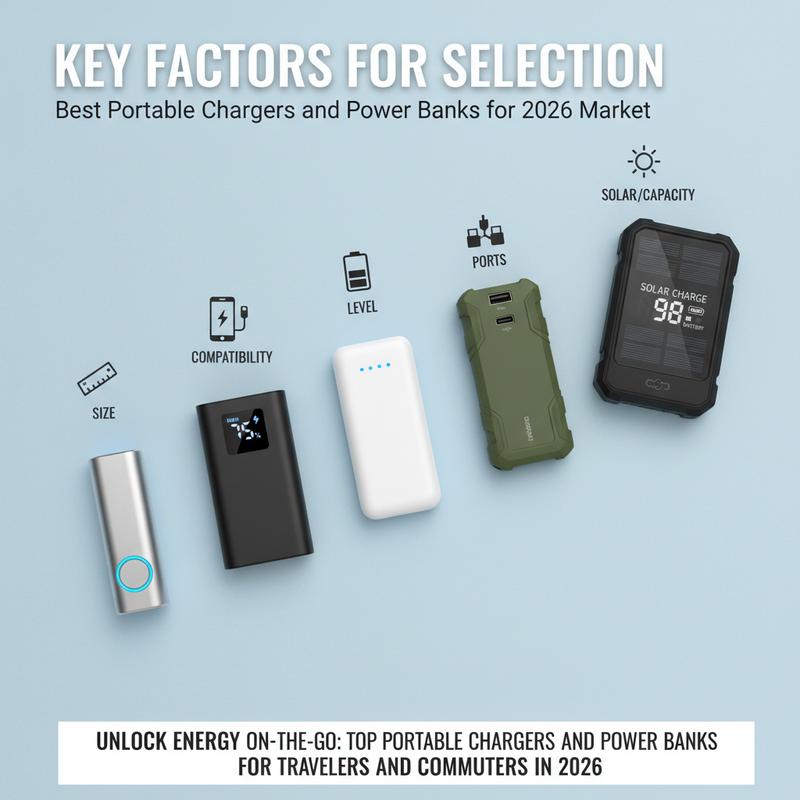
Higher capacity sounds great, but it only helps if it matches how you’ll use it. A 5,000 mAh charger is fine for quick emergency boosts, usually around half to a full phone charge. A 10,000 mAh power bank is the go-to size for many people, with 1–2 full charges. Once you hit 20,000+ mAh, you’re in travel and multi-device territory, but you’re also carrying more weight and dealing with longer recharge times. And don’t forget conversion losses—most power banks deliver about 60–70% of their rated mAh in real use.
Power Output and Fast Charging
Fast charging isn’t a “nice to have” anymore. USB-C ports with 20–30 W outputs are what modern phones and small tablets want. Bigger devices might need 45–65 W or more. Support for USB-PD and PPS helps with compatibility across different brands and devices. And bi-directional high-wattage USB-C ports are especially handy because they speed up both device charging and the time it takes to recharge the power bank itself.
Size, Weight, and Portability
If you plan to carry it daily, size and weight matter a lot. The 5,000–10,000 mAh range, often around 100–200 grams, is usually easy to toss in a bag and forget about. Once you go past 20,000 mAh, it gets bulkier, but many people accept that for travel or backup use. In 2026, you’ll also see more ultra-slim designs and mini direct-plug models that fit in small spaces like running belts or compact bags.
Ports, Features, and Extras
Ports can make or break a power bank. At minimum, you’ll want USB-C (in/out) plus USB-A. Higher-end models often include multiple USB-C ports so you can charge more than one device quickly. Built-in cables, pass-through charging, magnetic wireless charging attachments, and kickstands can be genuinely useful depending on how you charge. A clear, accurate display for remaining capacity is another feature you’ll appreciate pretty fast.
Safety and Build Quality
Safety matters as much as performance. Stick with models using reliable Li-ion or Li-poly cells and built-in protections like over-current, over-voltage, and short-circuit protection. Build quality counts too—strong shells and reinforced ports usually last longer, especially if you travel a lot. If you need something for outdoor use, rubberized finishes and IP ratings for dust and water resistance can be a big plus.
Keeping these points in mind makes it much easier to pick the right power bank in 2026—one that’s worth the money and works the way you expect.
Final thoughts
The 2026 portable charger market is packed, but it gets a lot simpler when you focus on what matters: the features you’ll actually use, the best picks for your situation, the right mix of capacity and speed, and a few key specs that separate good models from frustrating ones. Do that, and you’ll end up with something that fits your travel or commute and keeps you connected when you need it.
Need help picking one? Look for a reliable portable charger or power bank for 2026 so your devices are ready to go wherever you end up.
Learn more: https://itcarolina.com/about/
About us
IT Carolina helps you pick and set up tech that fits a mobile lifestyle. We get what travelers and commuters deal with when they’re trying to stay connected and keep everything charged on the go. Our know-how goes past home entertainment—we also help you find the right portable charging setup so you’re not stuck with dead devices at the wrong time. If you want straightforward advice and support to keep your gear running, IT Carolina can help you get it sorted before you hit the road.