As technology advances, DDR5 promises speed and efficiency, yet DDR4 continues to hold its ground as a reliable and cost-effective solution for many users. From everyday computing and competitive gaming to professional tasks, DDR4 offers viable performance without breaking the bank. This article delves into three key aspects—performance comparisons, cost-effectiveness, and stability—to understand why DDR4 remains a strategic choice. You’ll discover how DDR4 still meets the demands of general PC users, gamers, and professionals alike, even as we navigate the technological landscape of 2025.
DDR5 vs DDR4: Performance in Practice and Implications for 2025
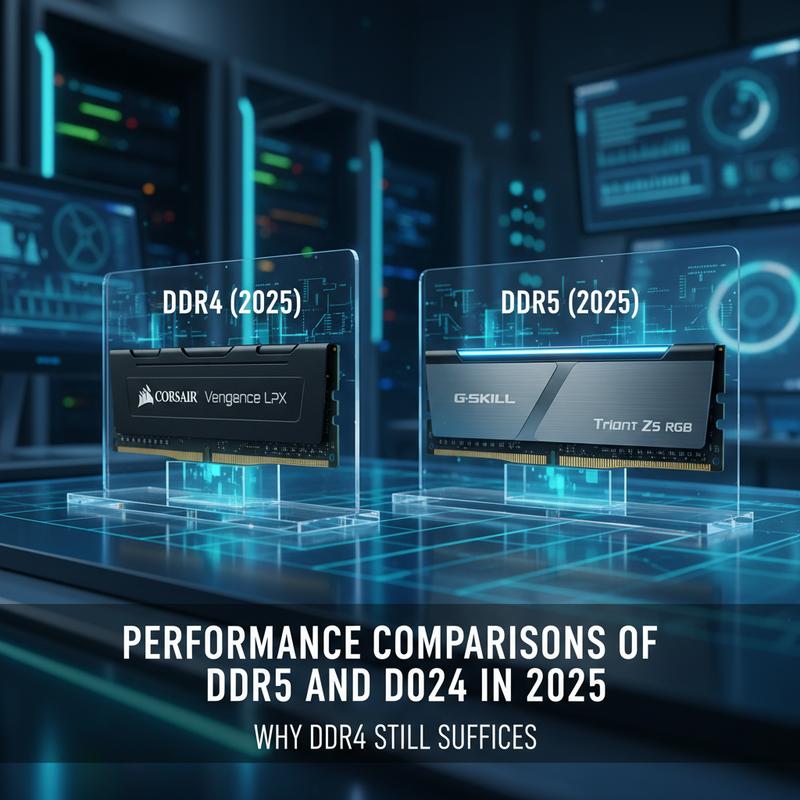
In the ongoing debate of memory technology, the choice between DDR5 and DDR4 is about understanding nuanced performance dynamics against practical requirements and budgetary limitations in 2025. While DDR5 brings forward impressive specifications, DDR4 remains a worthwhile contender for a broad spectrum of computing needs, offering commendable value and performance.
DDR5 is a leap forward technologically, promising faster data rates and greater bandwidth capabilities. Operating at speeds from 4800 MT/s to a staggering 8400 MT/s, DDR5’s potential bandwidth skyrockets to around 68.90 GB/s, a clear generational leap from DDR4’s 39.26 GB/s at maximum capacities of 2133–3200 MT/s. This peak performance is particularly pronounced in memory-intensive applications such as video editing, 3D rendering, and complex computing tasks, where the dual 32-bit channel architecture of DDR5 offers superior throughput efficiency.
For gamers, the story unfolds with some intricacies. At lower resolutions like 1080p, where the CPU and memory play significant roles, DDR5 delivers a noticeable frame rate lift of 3% to 10% in visually demanding titles like PUBG and Cyberpunk 2077. Yet, this boon diminishes as the resolution scales up, where GPU prowess becomes the primary bottleneck, making DDR4 a viable candidate for reasonable performance at competitive frame rates.
A critical aspect of the memory dialogue is latency—a factor often masked by sheer speed metrics. DDR4 typically offers CAS latencies between 14 and 22, whereas DDR5 hovers in the range of 36 to 40. This lower latency in DDR4 ensures quicker access to existing computational data, which is pivotal in real-time scenarios such as esports. Games that prioritize low latency over bandwidth, like CS2 or Valorant, may not markedly benefit from DDR5’s higher bandwidth if it comes at the cost of increased latency.
Beyond the raw performance considerations, the power efficiency of DDR5—operating at 1.1 volts as opposed to DDR4’s 1.2 volts—equates to lower heat production and marginal power savings, which can be attractive for energy-conscious setups. Moreover, DDR5 offers on-die Error Correction Code (ECC), enhancing data integrity, especially pivotal for professional environments managing critical workloads.
The relevance of DDR4 in 2025 is bolstered by cost factors. DDR5 modules demand a premium, approximately 50%–60% higher than approximated costs for DDR4, and compatible motherboards further exacerbate the price disparities. For users who prioritize economic efficiency, DDR4 stands as a logical choice, offering satisfactory performance for everyday tasks without the financial strain of adopting the latest technology.
DDR4’s enduring practicality is evident for those entrenched in existing systems. The leap to DDR5 entails comprehensive upgrades—new RAM, motherboards, possibly CPUs—which can deter many from switching, especially when current systems meet their computing needs adequately. This aligns DDR4 as a key option for incremental system enhancements without forsaking earlier investments.
For high-end new builds aiming to tackle future demands, DDR5 opens avenues with higher capacity modules up to 128GB per DIMM and substantial performance headroom, aligning well with systems designed for 144Hz or 4K gaming environments, or extensive content creation tasks.
Ultimately, choosing DDR4 or DDR5 hinges on specific user needs, budgetary constraints, and anticipated usage scenarios. For general computing, streaming, competitive gaming, and basic multitasking, DDR4 admirably suffices. Conversely, for those aspiring for cutting-edge performance and expansion potential, DDR5 presents itself as a worthy investment.
The memory landscape is evolving, and staying informed about the unique benefits of each technology can guide users towards making informed choices. As of now, DDR4 continues to be entrenched as a competent option, holding relevance even amidst the undeniable prowess of newer technologies such as DDR5.
For more insights into technology decisions and optimizations, check out our IT Support Services for tailored advice.
The Cost-Conscious Future: Evaluating DDR4’s Economic Viability vs. DDR5 in 2025

In the dialogue between DDR5 and DDR4, particularly as we stand in 2025, the conversation has shifted from pure performance metrics to economic sensibility. With memory prices having reached an unanticipated parity, consumers are now left to navigate an unprecedented pricing landscape that muddles traditional buying advice.
The year 2025 marks a notable moment in the saga of computer memory. Historically, DDR4 has been the stalwart servant, providing adequate performance at a fraction of the cost associated with its more modern successor, DDR5. However, what was once a clear-cut economic distinction has blurred. The typical cost advantage of DDR4 has dissipated, not through a drop in DDR5 prices as might be expected with widespread adoption, but due to a dramatic upswing in the costs of both memory types. This shift can primarily be attributed to acute supply shortages, a condition that has seen DDR5 prices climb by a massive 80% to 130% since September 2025.
Simultaneously, DDR4 hasn’t remained immune to these pressures, showcasing price hikes of 50% to 70% in the same timeframe. To contextualize these fluctuations, one might consider the example of a 32GB DDR5-6000 kit, which increased from under $95 in mid-2025 to approximately $184 by October, a stark 94% escalation. Similarly, the price of a comparable DDR4-3600 kit more than doubled, leaping from roughly $70 to $161. Such shifts signify a dramatic reorientation of the marketplace.
Brand-specific impacts further complicate the narrative. Not all manufacturers have been equally affected by these market dynamics. For instance, over a span of just two months, Kingston and Patriot showed relatively moderate price increases—46% and 43%, respectively—compared to G.Skill, which saw a drastic 138% price surge. This variability underscores the complexities involved in navigating current market conditions.
On the wholesale side, a different story unfolds. Despite parity at the consumer level, DDR4 still commands a significantly higher spot price than DDR5. As of late 2025, 16GB DDR4 chips had an average session price of $24.55, starkly contrasting with $15.20 for equivalent DDR5 solutions. These figures represent historical outliers, revealing a market struggling under the weight of supply chain constraints and deliberate manufacturer strategies aimed at moving beyond DDR4.
For those building on a budget, past wisdom would have steered them towards DDR4 to save costs while sacrificing little in terms of performance. However, given present conditions, price matters less in decision-making than platform compatibility and future-proofing. As DDR4 is gradually phased out, investing in DDR5 for new builds seems prudent, aligning with industry evolution despite elevated entry costs.
Conversely, owners of existing DDR4 systems find little economic justification in transitioning to DDR5. The comprehensive costs associated with upgrading the motherboard, CPU, and RAM far outstrip any performance gains for typical users. Thus, preserving an existing DDR4 setup remains the most financially sound option until market conditions normalize. For servers and infrastructure projects, refurbished DDR4 memory serves as an economical choice, ensuring continued functionality without the premium price tag of new components.
Looking forward, the trajectory seems poised to maintain its current course. Supply shortages are expected to persist through mid-2026, with DDR5 prices potentially increasing 30–50% each quarter. By mid-2026, DDR5 modules could see prices rising to approximately $30 each—a significant leap from their cost a year prior. Meanwhile, DDR4, albeit potentially stabilizing, is unlikely to see price reductions due to strategic supply constraints aiming to phase out the older technology.
In sum, DDR4 and DDR5 stand on nearly equal economic footing in 2025, transforming the usual calculus of memory purchasing decisions into a question of broader system planning and lifecycle management. As we advance, DDR4’s legacy will likely hinge on its ability to serve existing systems reliably, while DDR5 takes the fore for new builds and future-proof agendas. Amidst these changes, clear guidance and patient navigation become crucial for consumers facing an evolving memory market.
Enduring Stability and Practicality of DDR4 in 2025: Navigating Market Challenges
In 2025, as technology continues its relentless march forward, the landscape of computer memory technology is at a pivotal point. Despite the advent of DDR5, DDR4 remains a cornerstone for many, especially within the realm of everyday computing tasks. The enduring stability and practicality of DDR4 are significant, particularly given the broader market forces that are reshaping the technology landscape.
Technical Performance and Compatibility
DDR4 continues to meet the needs of typical computing activities with admirable efficiency. For many users engaged in routine tasks such as web browsing, document processing, or using productivity software, the performance of DDR4 is often indistinguishable from that of its successor, DDR5. While certain memory-intensive applications reveal a stark performance difference—DDR5 showcasing enhancements between 24% and 45% over DDR4—the impact of these improvements varies widely based on the application[3].
Compatibility is a key strength of DDR4. Its widespread support across various platforms ensures that users can maintain existing systems without immediate need for replacement. AMD’s AM4 socket remains a steadfast supporter of DDR4, while Intel’s dual compatibility with DDR4 and DDR5 in their recent generation offerings provides flexibility for users not ready to transition to entirely new hardware configurations[4]. This adaptability maintains DDR4’s relevance, allowing it to serve those upgrading budgets or maintaining established systems.
Market Challenges and Pricing Reality
However, the staying power of DDR4 is less defined by its technical limitations and more by significant market challenges. A “pricing apocalypse” has descended upon the memory market, raising the prices of DDR4 and DDR5 dramatically—sometimes escalating as much as 150% to 300% in a single year[2]. This surge is chiefly driven by the explosive demand for server-grade memory in the expanding AI and data center sectors, prompting manufacturers to pivot their production priorities towards higher-margin DDR5 and away from consumer-grade DDR4[1].
Manufacturers like Micron and Samsung have strategically shifted focus, which exacerbates the supply strain for consumer DDR4. Such strategic redirection suggests a severe reduction in consumer availability, further discouraging investment in DDR4 from both a compatibility and economic perspective. Samsung’s reported 50% rise in RDIMM contract prices further corroborates the continuing emphasis on high-margin, server-oriented applications, starving the consumer market of needed resources[1].
Long-Term Viability Concerns
The memory industry’s standard operating cycle, typically extending over 3.5 to 4.5 years, is undergoing a profound transformation under AI-driven pressures. Analysts predict these disruptions could persist, reshaping market dynamics for the foreseeable future[1]. The shift away from consumer memory segments is further underscored by Micron’s projected withdrawal from the consumer memory market in favor of AI-focused production by 2026[2]. This move signals an industry-wide pivot that underscores uncertain prospects for DDR4 longevity and pricing stability.
Practical Recommendations
For consumers prioritizing everyday computing tasks, DDR4 remains viable, especially if they own existing systems that still perform adequately. However, practical financial considerations are becoming increasingly unfavorable. DDR4’s pricing, now either equivalent to or surpassing DDR5, diminishes its once clear value advantage[4]. Consequently, investing in DDR4 for new setups or upgrades doesn’t align well with a forward-looking strategy.
For those contemplating new systems or major upgrades, caution is advised against investing in DDR4. Despite its robustness and technical sufficiency, the combination of inflated costs, supply de-prioritization, and the transition away from DDR4 support advises a pivot towards DDR5. This forward-ready option, although experiencing its own pricing hikes, promises sustained relevance amid the ongoing industry shift.
In this transformative era, DDR4’s stability and practicality are overshadowed by market forces that are reshaping consumer access. Understanding these shifts is paramount for making informed decisions in a landscape where the distinction between maintaining the status quo and seizing future technology holds significant financial and practical implications. Embracing strategies for upgrading could aid in navigating these transitions, ensuring that computing needs are aligned with technology’s evolving trajectory.
Final thoughts
In summary, DDR4 continues to stand out in 2025 for those prioritizing cost and stability without needing the utmost in cutting-edge speed. While DDR5 offers benefits for high-end builds and future-proofing, DDR4’s reliable performance and affordability make it a practical choice for a wide range of computing needs. Whether you’re upgrading an existing system or building a new setup, DDR4 maintains its place as a compelling option, offering a balanced approach to performance and value.
Still running DDR4? You’re not behind—you’re optimized. Let IT Carolina show you how to get peak performance without the latest hype. Call us today and power up your rig the smart way!
Learn more: https://itcarolina.com/about/
About us
At IT Carolina, we understand that not everyone needs the latest tech to achieve top-tier performance. That’s why we help gamers, professionals, and everyday users unlock the full potential of their DDR4 systems, even in 2025. From expert RAM configuration to performance tuning and network optimization, our technicians make sure your setup runs fast, stable, and ready for anything—from competitive gaming to professional workloads. Trust IT Carolina to prove your current gear still packs a punch.