The digital landscape of 2025 sees Apple devices thrust into the limelight of cybersecurity threats. The persistent myth that Macs are immune to viruses no longer holds up. As Apple’s market share grows and hackers deploy more advanced techniques, the risk to Mac users skyrockets. This article dives into the changes necessitating heightened awareness among Mac users. First, we examine how a booming market for Apple products attracts cybercriminals. Next, we explore the sophistication of modern malware specifically targeting Macs. Finally, we compare Mac and Windows security to dispel the myths of Apple invincibility. Understanding these dynamics is crucial for safeguarding your devices against increasingly insidious threats.
The Rise of Mac as a Prime Target: Market Share’s Impact on Security Myths in 2025
The allure of Apple’s macOS as a bastion of security has been a comforting myth for far too long. Over the years, Macs garnered a reputation for being impervious to the malware and viruses that plagued their Windows counterparts. This belief was largely due to macOS’s smaller market share, which made it a less attractive target for cybercriminals focused on maximizing their reach and impact. Fast forward to 2025, and the tech landscape has shifted dramatically—Macs are no longer perceived as immune, and their growing market share has made them an attractive target for malicious actors.
In the past, the smaller footprint of macOS users meant that hackers had little incentive to develop mac-specific threats. Windows, with its dominant share, was the low-hanging fruit, offering a tantalizing victim pool with high potential returns. However, as Apple products have become synonymous with innovation and luxury, more users—both consumers and businesses—have gravitated towards the brand. This surge in popularity has not gone unnoticed by those with nefarious intentions.
The expansion of Apple’s market share has transformed the incentives for cybercriminals. A wider user base inherently means a larger audience for exploitative tactics, making the effort to craft macOS-specific malware worthwhile. Hackers now see the value in targeting macOS, understanding that a successful attack could not only yield financial data from a broader audience but also access lucrative targets such as developers and individuals in the financial sector.
Compounding the problem is a lingering complacency among many Mac users. The outdated belief in macOS’s invulnerability discourages some from adopting robust security measures. Some users still eschew antivirus software, relying on the operating system’s default protections. This complacency further incentivizes cybercriminals, who are well aware that a successful breach is more likely when defenses are weak.
Today’s threat landscape reflects a sophisticated array of tactics specifically aimed at the macOS environment. Malware that once bypassed Apple users is now designed to penetrate their defenses directly. From browser-targeting scripts to intricate phishing schemes masquerading as GitHub repositories or fake software updates, the threats are both diverse and innovative. Meanwhile, sophisticated techniques like deepfake interactions during virtual meetings aim to deceive even the savviest users, enhancing the illusion of safe, credible interaction while concealing malicious intent.
The notion that Macs don’t require the same level of security vigilance is further undermined by the increasing exploitation of zero-day vulnerabilities within macOS. Apple’s cybersecurity team works diligently to release emergency patches, yet the reality is that hackers are often a step ahead, leveraging vulnerabilities before they are publicly known and addressed.
For present-day Mac users, this context demands a proactive approach to cybersecurity. Comprehensive protection is no longer optional but a necessary aspect of owning and operating a Mac. Users are advised to install trusted antivirus and anti-malware tools, keep their systems and applications up to date, and practice caution when encountering unfamiliar downloads or unsolicited communications.
Furthermore, adopting strong authentication practices and considering additional layers of protection such as Virtual Private Networks (VPNs) can provide enhanced security. The evolution of the threat landscape for Macs signifies the end of an era where rudimentary security practices sufficed. Instead, a new era demands a diligent, informed approach to defending against the sophisticated threats of today.
In this evolving landscape, insights into vital security measures can be found in resources like the article How One Click Can Cost You $10,000—and How to Stop It: Real Story. Embracing such guides can empower Mac users to protect themselves more effectively and ensure they stay ahead of malicious threats.
Harnessing Complexity: The Sophisticated Threats Redefining Mac Security in 2025
The once enduring myth that ‘Macs don’t get viruses’ has been thoroughly dismantled by the technological landscape of 2025. This shift is driven by a new wave of sophisticated cyber threats that have dramatically altered the security environment for macOS users. As these threats evolve, they capitalize on both technical vulnerabilities and the deceptive comfort of perceived immunity, creating an urgent need for heightened vigilance and protection among Mac users.
The statistics succinctly communicate the gravity of the situation. A staggering 66% of Mac users reported encountering at least one cyber threat in the past year, catapulting the prevalence of malware to a prominent position, only behind data breaches. Yet, despite these numbers, the myth of Mac invulnerability persists, making users more susceptible to these threats. Kaspersky’s systems documented an alarming average of 500,000 malicious files per day in 2025, highlighting a somber 7% escalation from the previous year. Among the flood of threats, the surge in password stealers, spyware, and backdoor detections reveal a sharp spike in malicious ingenuity.
The landscape of macOS malware itself has transformed dramatically, advancing from basic data-stealing tools to sophisticated, modular threat platforms. These platforms include features like credential reuse support and REST-style tasking, mirroring the capabilities found in Windows-targeted threats. This evolution is not only about increased complexity but reflects a broader trend of cross-platform malware development. For example, the notorious AMOS malware series experienced a 300% spike in detections in a single month of 2025, demonstrating how quickly threats can propagate through networks.
What further complicates the security picture is the strategic proliferation of threat variants. The year 2025 witnessed a 67% increase in macOS backdoor variants and a 17% rise in stealer variants, a testament to criminal resilience and adaptability. This expansion in variants is fueled by automated tools that generate malware versions faster than traditional detection systems can adapt, giving attackers a pronounced advantage. The democratization of cyber-attacks via the ‘malware-as-a-service’ economy has only exacerbated this issue, reducing barriers to entry for aspiring cybercriminals. At the heart of this economy lies commoditized malware offerings bundled with sophisticated support and tutorials, transforming individuals with limited skills into potential threats.
The entry point of these attacks has become increasingly cunning, as social engineering techniques like ‘ClickFix’ rise to prominence. This method, leveraging human behavior as a vulnerability, now accounts for 47% of successful breaches, demonstrating a shift from purely technical exploits to exploiting psychological susceptibilities. Consequently, the idea that Macs are intrinsically secure has become not just a fallacy, but a hazardous misconception.
Modern macOS malware is no longer about mere data theft. The range of capabilities has broadened significantly, offering attackers tools to siphon passwords from browsers, compromise cryptocurrency wallets, extract cloud credentials, and more. This data collection not only facilitates immediate theft but also feeds into a larger criminal network, where stolen data is meticulously processed and transformed into marketable products on underground marketplaces.
Artificial Intelligence has emerged as a pivotal component in attackers’ arsenals, enabling rapid iteration and deployment of malware variants. While Apple remains committed to responsible disclosure and methodical updates, this slow-rolling security strategy faces an unprecedented challenge from the fast-paced, AI-driven agenda of criminal developers. Thus, the landscape is heavily skewed in favor of those who persistently attempt to bypass defenses using cutting-edge technology.
As these threats envelop global regions from APAC to LATAM, each experiencing notable increases in specific malware types, Mac users worldwide face a unified threat landscape—a phenomenon unseen in earlier technological epochs. The lingering perception of invulnerability poses a grave risk, leaving many Apple device owners at a critical disadvantage. Embracing robust antivirus solutions and proactive cybersecurity practices is now an imperative, not an option, for macOS users striving to safeguard their digital lives.
A Closer Look at Threat Parity: Unmasking Mac and Windows Security Realities in 2025
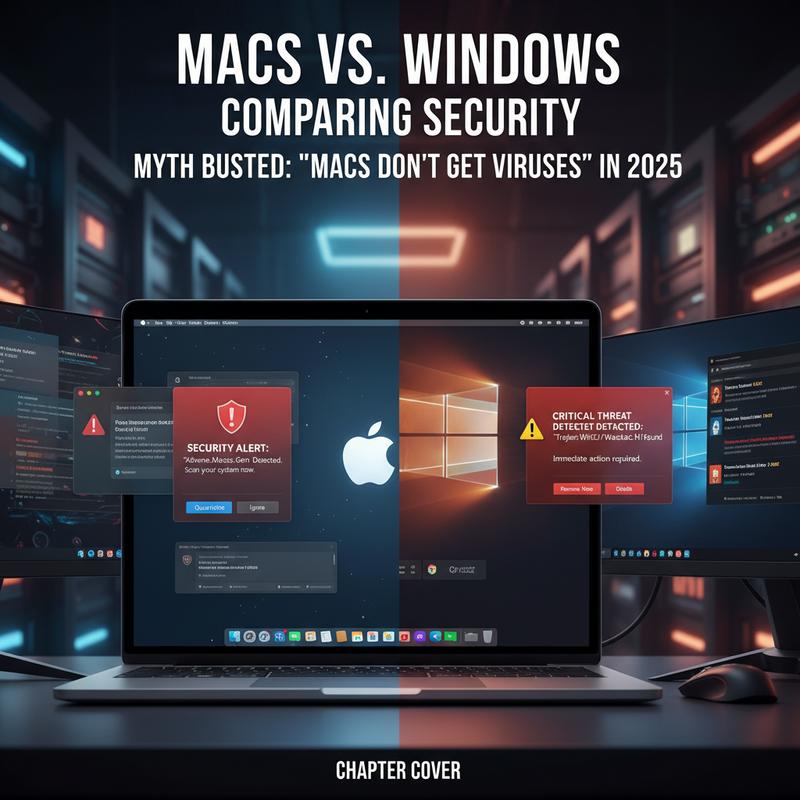
The persistent belief that Macs are immune to viruses has largely been dismantled as we progress further into 2025. This long-standing myth owes more to historical market dynamics than any innate technical resilience. For years, Mac users have held onto a false sense of security—a security blanket woven from Apple’s smaller market share, rather than any inherent superiority of the macOS during the golden years of Mac invulnerability.
The reality confronting us today is more nuanced. While it remains true that Macs experience fewer attacks than their Windows counterparts, this is primarily due to market share rather than any superior virus resistance. Historically, cybercriminals focused their attention on the reigning giant: Windows. This focus arose because attacking a Windows system could yield access to a far larger pool of targets. However, as Apple’s popularity surges, the tide is visibly shifting, and Macs are stepping into the cybercriminal spotlight.
Surveys reflect this change in landscape. A 2024 survey indicates that 19% of professionals managing Apple-exclusive environments reported cyberattacks in the past five years. This figure, while lower than the 31% and 34% reported by those in mixed or Windows-only environments, highlights a closing gap. Mac’s relative security advantage is shrinking, with the gap predicated more on past market dynamics than any technological invulnerability.
The distinction between Mac and Windows security frameworks also contributes to these evolving threat profiles. Apple’s approach to security leverages a closed ecosystem, which inherently offers a strong defense by limiting external inputs. Integral to this architecture are features like Gatekeeper, which polices app installations and updates, XProtect, which offers underlying malware scanning, and the Secure Enclave chip, providing hardware-level protection for sensitive data. By tightly controlling the software and hardware stack, Apple constructs a multi-layered security wall that has historically made unauthorized code execution more challenging.
Windows, on the other hand, adopts an open approach, embracing integration with third-party security solutions. It relies heavily on tools like TPM chips and Windows Defender to maintain a robust security posture. This open framework has its advantages, offering flexibility and adaptability desired by many businesses. The continuous invention in Windows security, such as a more aggressive patching schedule, demonstrates a commitment to proactive threat management, albeit with a more reactionary slant. Microsoft Defender serves as a comprehensive foundational shield, featuring firewalls, password protection, and comprehensive parental controls.
The diverging philosophies also extend to update handling. Microsoft’s rapid and frequent patching is indicative of a responsive attitude toward emerging threats—an ethos of adaptation. Apple’s less frequent updates reflect a strategy with potentially more holistic insights into risk management, or perhaps a different prioritization of vulnerabilities.
Ultimately, the security struggle between Mac and Windows is a tale of evolving landscapes and user assumptions. Macs’ security reputation was never underpinned by invincibility but rather by the lesser focus of cybercriminals until now. As Mac adoption grows, users must shift their paradigms—adopting security practices as rigorously as they would in Windows environments. The necessity for regular updates, strong passwords, and an astute awareness of phishing threats is universal. For more insightful advice on maintaining robust security measures, exploring this checklist for onboarding employees can offer practical tips.
The conclusion is clear: Macs and Windows face distinct, yet increasingly similar challenges. As we progress through 2025, neither platform can rest on its laurels. In unison, they journey toward a common goal—holding the line against a seemingly inexhaustible incredulity of threats.
Final thoughts
In 2025, the myth of Mac invulnerability is thoroughly debunked. As Apple devices command a larger market share, they become prime targets for complex cyber threats. While Macs continue to offer strong security features, the sophistication of modern malware requires vigilant cybersecurity practices. By adopting robust antivirus solutions and staying informed about potential risks, users can protect their digital lives. Trustworthy digital hygiene is now essential for all, regardless of operating system, ensuring safety and privacy in the constantly evolving digital landscape.
Worried your Mac isn’t as secure as it used to be? Let IT Carolina protect your tech today!
Learn more: https://itcarolina.com/about/
About us
IT Carolina offers expert on-site support to protect your Apple devices from modern threats. As Macs face increasing risks from malware, phishing, and system vulnerabilities, our team ensures your system stays secure and optimized. From configuring reliable antivirus protection to securing your home network, we eliminate the guesswork and upgrade your defenses. Let IT Carolina help you keep your Mac running smoothly and safely—because in 2025, even Apple needs backup.