The 2026 Consumer Electronics Show (CES) brought a wave of technological marvels, yet some anticipated revelatory launches were conspicuously absent. As tech enthusiasts and common users alike wrapped up their show insights, five missing major announcements stood out. From anticipated GPU releases to groundbreaking processors, spectators were left with a sense of longing. This article delves into these absent innovations, examining their significance and why their absence at the show resonates with both developers and consumers. Each section will explore the promised advancements, potential impacts, and why their delay leaves such a void in the tech landscape.
NVIDIA’s GeForce RTX 50-Series: The Missing SUPER Refresh

As CES 2026 began, whispers of NVIDIA’s next potential juggernaut were rampant on the show floor and online, but the expected unveiling of the GeForce RTX 50-series SUPER refresh was conspicuously absent. NVIDIA enthusiasts and tech pundits had their eyes set on this highly anticipated mid-cycle update, which promet seek the promise of revolutionary upgrades mainly in memory technology.
Originally, NVIDIA had set a timeline aiming for a late Q1 to early Q2 release in 2026. Speculation was high that CES would witness the first official announcement, sparking excitement across the gaming and tech communities. This was meant to be the event where NVIDIA would showcase their upgraded GeForce RTX 5070, 5070 Ti, and 5080 graphics cards, all promising impressive enhancements, including the integration of denser GDDR7 memory modules.
These enhancements, featuring 3 GB per chip, would have propelled the RTX 5070 SUPER’s capacity to a robust 18 GB, and the RTX 5070 Ti SUPER and RTX 5080 SUPER models to a hefty 24 GB of GDDR7 memory. Such specifications were expected to significantly improve gaming experiences, providing gamers with smoother, quicker, and more responsive gameplay. Yet, no such unveiling occurred at CES, leaving fans with more questions than answers.
The absence of these developments at CES suggests NVIDIA might be pacing its technological breakthroughs deliberately. Some analysts propose that production or supply chain constraints could be factors, but others speculate that a strategic re-timing could play to NVIDIA’s favor amid current market dynamics. Could the delay impact GPU price trends in 2026? Find out more here.
The missing announcement is as intriguing as it is frustrating. For a company renowned for pushing graphical boundaries, this delay raises the stakes on what NVIDIA has planned next. Without any official confirmation, observers will continue to puzzle over NVIDIA’s next move.
The absence of the GeForce RTX 50-series SUPER refresh seems to be not just a gap in NVIDIA’s CES lineup, but a strategic play in a market teeming with competitive undertakings from AMD and Intel. This strategy keeps enthusiasts eager, albeit slightly disappointed, awaiting NVIDIA’s next showcase or unnanoced press conference, perhaps to catch the gaming world by storm with innovative offerings that surpass the rumoured SUPER refresh.
Meanwhile, the tech world eagerly anticipates further updates. As NVIDIA continues to hold its cards close to its chest, one thing is clear: when the GeForce RTX 50-series eventually gets its SUPER treatment, it is set to redefine graphics performance, setting a new benchmark industry-wide. Until then, the community remains on edge, eyes peeled for any hint of what NVIDIA has in the works.
NVIDIA’s Arm-Based Gaming Processor: The Anticipated No-Show at CES 2026

The tech world has been abuzz with rumors and speculation regarding NVIDIA’s next big leap into gaming processors, specifically its Arm-based N1X SoC. Touted to make its debut at CES 2026, the N1X processor was a hot topic and its non-appearance has left a noticeable void in the lineup of expected announcements.
NVIDIA’s foray into this realm was expected to set the stage for a head-to-head showdown with Qualcomm’s Snapdragon X2 Plus, which was unveiled at CES 2026. The anticipation surrounding NVIDIA’s N1X was not unwarranted. Reports suggested that NVIDIA was leveraging its robust GB10 Superchip architecture—best known for powering the DGX Spark—as the foundation for this exciting innovation. This potential match-up would have seen two tech titans battling it out in the gaming laptop domain, enhancing consumer choice and setting new benchmarks for performance.
Details leading up to CES indicated that the N1X would boast a configuration of 20 Arm v9.2 cores strategically divided into two clusters, each sporting 10 cores. These cores would be supported by a considerable 32 MB of shared L3 cache, ensuring smooth and powerful performance. Each core, equipped with its private L2 storage, was set to enhance processing efficiency substantially.
Of particular interest was the anticipated memory subsystem, designed to capitalize on a unified LPDDR5X-9400 fabric operating on a 256-bit bus. This design could potentially support up to 128 GB of memory, delivering a raw bandwidth of approximately 301 GB/s. While these specifications were impressive, it remained unclear whether such memory capabilities would extend to consumer-ready laptops, leaving tech consumers and developers with lingering questions on the feasibility of these high specs in everyday devices.
Power consumption and connectivity were also areas of focus. The N1X’s package was estimated to have a thermal design power (TDP) of around 140 watts, which raised considerations regarding heat management in compact gaming laptops. Moreover, emerging details suggested that PCIe 5.0 integration would be included to facilitate high-speed NVMe SSD connectivity. This aspect alone would have marked a significant enhancement, potentially driving interest from both gaming enthusiasts and professionals requiring powerful mobile workstations.
Though the anticipated NVIDIA announcement did not materialize, the excitement around such cutting-edge performance chips serves as a reminder of the industry’s relentless pace and the high stakes involved in launching next-gen hardware. The Arm architecture’s blending with NVIDIA’s computing prowess has only heightened interest in what the future of gaming and professional computing could hold.
As tech enthusiasts and industry insiders continue to speculate on the eventual arrival of the N1X, the non-event at CES should not be seen as a setback but rather a delay in an eagerly awaited evolution. For those interested in how NVIDIA continues to adapt and lead in technology innovation, staying up-to-date with further announcements will be key. Windows ARM had quite a good year on the verge with promising partnerships and advancements.
In conclusion, while the absence of NVIDIA’s Arm-based gaming processor announcement at CES 2026 was disappointing, it underscores the dynamic nature of tech showcase events. Fans can remain optimistic about what NVIDIA will eventually unveil as the burgeoning demand for high-performance, low-power processors continues to grow.
AMD’s Unveiled Secret: Ryzen 9 Expectations Dashed

The buzz surrounding CES 2026 included high hopes for AMD’s latest powerhouse, the Ryzen 9 9950X3D2. Anticipation had built to a crescendo as tech enthusiasts speculated about its reveal. Excitement was palpable, especially since AMD’s CEO, Dr. Lisa Su, was scheduled to deliver a keynote at the event. However, the much-rumored processor remained conspicuously absent, leaving fans and industry insiders alike with more questions than answers.
In recent years, AMD has consistently pushed the envelope with its high-performance processors, with the Ryzen series often stealing the limelight at major tech events. The Ryzen 9 9950X3D2 was expected to make a significant impact with its reported 16 cores and 32 threads, equipped with a remarkable 192 MB of L3 cache thanks to its innovative 3D V-cache technology. These specifications seemed tailored not only for gamers but also for creative professionals requiring memory-intensive computing power.
Yet, despite these promising specs floating through the rumor mill, AMD chose not to showcase this particular processor at CES. Instead, they introduced the Ryzen 7 9850X3D—a capable CPU in its own right, but perhaps a step down from the public’s lofty expectations. This Ryzen 7 variant shares the 3D V-cache design ethos, with its performance benchmarks being an upgrade over earlier iterations. However, it merely casted a shadow, maintaining interest but hardly the level of awe that a Ryzen 9 reveal would have generated.
What could have held AMD back? One possible reason could be the untold challenges of heat management. Reports suggested the Ryzen 9 9950X3D2 would come with an increased TDP of 200 W, up from its predecessor’s 170 W. This hike implies AMD would need effective thermal solutions to ensure stability under heavy loads—something imperative for the processor’s performance in high-stakes applications, from gaming marathons to intensive data processing tasks.
Another consideration is market positioning. The competitive landscape has shifted with Intel and NVIDIA presenting formidable alternatives (though NVIDIA’s own anticipated launches were similarly delayed). AMD might be working behind the scenes to fine-tune its offering, ensuring the Ryzen 9 9950X3D2 doesn’t just meet expectations but exceeds them sustainably and reliably in real-world environments.
It’s also possible that the ecosystem readiness played a role. With the burgeoning demand for processors that support increasingly sophisticated AI workloads and blazing-fast gaming experiences, ensuring compatibility with upcoming motherboards and memory solutions could be critical. Therefore, AMD might have opted for a conservative approach, waiting to align the release with a broader hardware ecosystem evolution.
Despite the no-show at CES, the community remains optimistic. Historically, AMD has leveraged its prowess in innovation to deliver robust solutions that redefine industry norms. It’s reasonable to suggest that the Ryzen 9 9950X3D2, whenever it does officially debut, could set a new standard in processor performance.
In the interim, while many walked away from CES 2026 with a twinge of disappointment over this absence, the conversation continues regarding what this no-show could mean for the market. AMD has repeatedly shown strategic foresight, suggesting that perhaps this delay is more tactical than symptomatic of unforeseen issues. The anticipation continues, fueled by a history of disruption and excellence.
For anyone still buzzing with speculation, it’s worth considering how AMD’s future unveilings might fit into the broader tech landscape. Perhaps additional insights and perspectives can be found by exploring CES 2026’s other highlights and technological innovations. In doing so, the context of this absence might become clearer, and the excitement for AMD’s upcoming innovations could crescendo once more. Explore more tech insights and updates over at IT Carolina.
Intel’s Arrow Lake Refresh: An Anticipated Launch That Missed the Mark
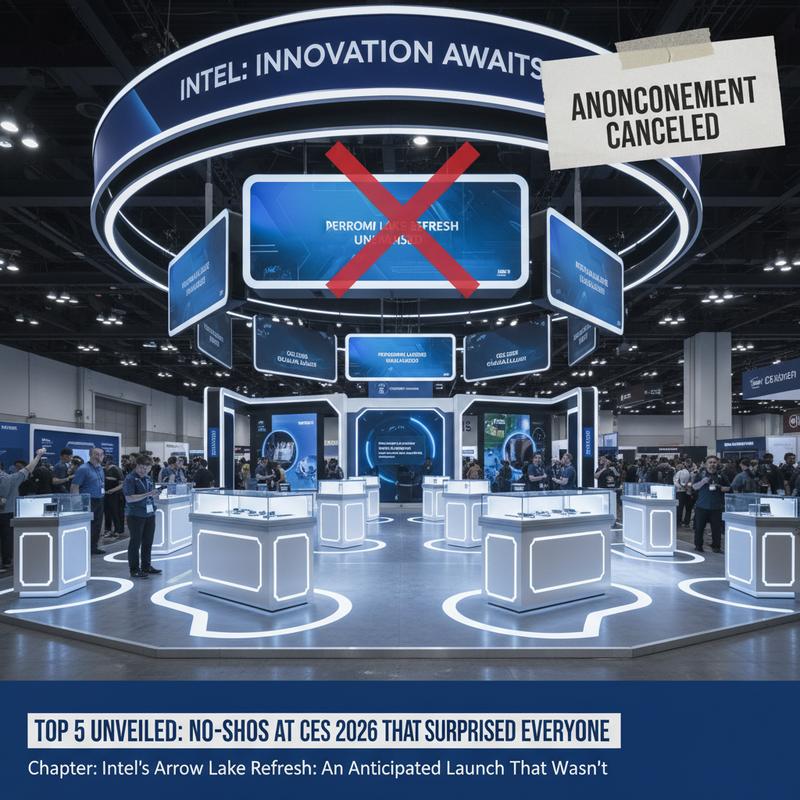
When CES 2026 rolled around, anticipation was buzzing around Intel’s anticipated ‘Arrow Lake Refresh’ of the Arrow Lake-S desktop CPUs. However, attendees were left empty-handed, as the tech giant remained silent on what many expected to be a show-stopping reveal.
The rumored refresh was set to augment Intel’s existing Arrow Lake lineup, providing gamers and enthusiasts with tweaks geared towards enhanced performance. The whispers in the tech community suggested new SKUs like the Core Ultra 9 290K Plus, featuring improved clock speeds compared to its predecessors. The enhancements were projected to promise a modest boost of around 100 MHz on both base and boost frequencies.
Intel had also eyed improving the memory controller capability, with plans to support DDR5 memory at 7,200 MT/s—a leap from the existing 6,400 MT/s currently supported in the Arrow Lake CPUs. The aim was clearly to address some of the previous generation’s hiccups, offering gamers that extra performance edge necessary for demanding tasks and gameplay.
Yet, as CES 2026 drew to a close, Intel’s focus was evidently shifted elsewhere. Rather than showcasing the Arrow Lake Refresh, the company chose to spotlight its forthcoming ‘Panther Lake.’ This pivot left tech enthusiasts speculating whether enthusiasts would ever see the rumored tweaks to the Arrow Lake processors, or if such plans might be entirely scrapped given Intel’s future roadmap.
The no-show was particularly noticeable given that announcements from other CPU rivals were happening at the same time. It left observers wondering if Intel’s strategic prioritization of future products over optimizing its existing lines might signal a shift in their approach to consumer desktop markets.
Despite the absence of the Arrow Lake Refresh at this year’s CES, gamers and tech pundits remain hopeful for its possibility. With Intel’s Nova Lake expected to hit markets soon, any indication of the Arrow Lake Refresh could be overshadowed unless it packs unique, compelling offerings.
This missed opportunity at CES 2026 provides an intriguing look into how tech behemoths, like Intel, navigate product development strategies in real-time and balance innovation with market demands. For those keen on what’s next in the CPU world, keeping an eye on Intel’s future announcements could be crucial in understanding where they plan to steer their consumer technology.
To keep up with the latest on Intel’s plans, including the rumored ‘Panther Lake,’ visit here.
Intel ARC B770: The High-Performance GPU That CES 2026 Missed
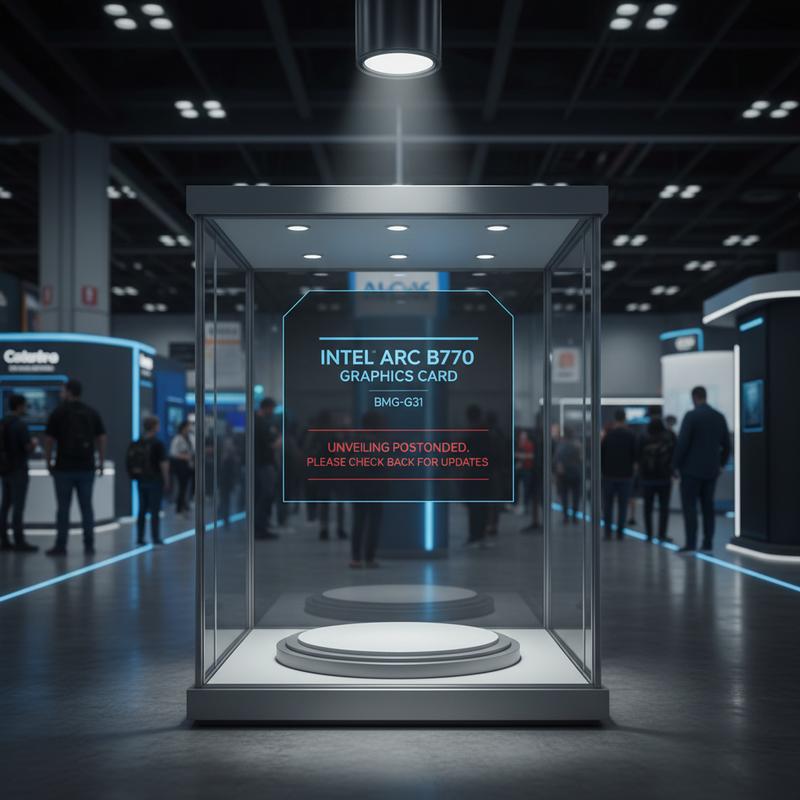
Despite the buzz surrounding CES 2026, Intel’s highly anticipated Arc ‘Battlemage’ B770 graphics card was nowhere to be seen, leaving tech enthusiasts in suspense. The B770, based on the BMG-G31 die, boasted an impressive 32 Xe2 cores and 16 GB of GDDR6 memory on a 256-bit interface. This GPU was expected to break ground in consumer graphics with a formidable 300 W TDP, reflecting Intel’s most powerful offering to date in their burgeoning Arc series.
Given the excitement surrounding its specifications, the absence of the Arc B770 at CES was palpable. Intel’s keynote presentation instead prioritized discussions around ‘Panther Lake,’ the next-generation laptop CPUs, neglecting any mention of their promising leap in discrete graphics technology. This sidestep has left consumers and industry experts speculating about Intel’s strategic delay in releasing the B770.
The Arc B770 has been poised as a major contender in the high-end GPU market, with its engineering aimed at outperforming previous flagships like the Arc ‘Alchemist’ A770. The step to a 300 W board-level power rating signifies Intel’s intent to push performance boundaries, likely providing a significant leap in graphical output for gaming and professional applications. However, as these details remain technically unconfirmed, the tech community is left in a holding pattern.
Intel’s decision to skip the launch of the Arc B770 at CES might be a strategic maneuver aligned with their broader product roadmap. With stiff competition from NVIDIA and AMD, timing in the release of new hardware often dictates market impact and adoption. Analysts suggest that Intel might be optimizing the B770’s capabilities further or aligning its launch with other products for a bigger market splash, as implied by the ongoing developments around ‘Panther Lake.’
For those following Intel’s journey within the GPU landscape, this delay is not new. The company has been oscillating between breakthroughs and setbacks as it builds a foothold within this competitive arena. The Arc series symbolizes their aggressive approach to gaining market share against established GPU giants—an effort underscored by their uncommon step into high-TDP territory with the B770.
The tech community remains eager to directly observe the Arc B770’s performance, particularly how its architecture advances graphical computations. As enthusiasts and developers yearn for more substantial upgrades, Intel’s potential impact on the GPU market remains speculative yet promising. Until more concrete details emerge, the B770 remains an ambitious project on the horizon of consumer tech.
For more insights into the impacts of hardware developments and market trends, visit our blog.
Final thoughts
The notable absences at CES 2026 encapsulated both the unpredictability and bold ambitions of the tech industry. While missing launches like NVIDIA’s GPUs and Intel’s processors hint at the challenges manufacturers face, they also maintain community engagement and speculation. As companies adapt to evolving technology demands, these absences may pave the way for future innovations with refined dynamics. For enthusiasts, this means a longer wait for cutting-edge hardware, but potentially more polished and groundbreaking products in time. Stay tuned to see how these anticipated technologies evolve beyond CES, shaping the landscape of electronics in unforeseen ways.
Source: https://www.techpowerup.com/345051/the-5-biggest-no-shows-of-ces-2026