A recently discovered flaw in the UEFI firmware of leading motherboard brands such as ASRock, ASUS, GIGABYTE, and MSI poses significant security risks, allowing for Direct Memory Access (DMA) attacks during the early boot stage. This vulnerability can potentially let malicious actors bypass conventional security measures to gain unauthorized access and control. As tech enthusiasts and everyday users grow increasingly concerned about cybersecurity, understanding the implications of this flaw becomes crucial. This article explores the nature of this vulnerability, the potential impacts on both casual users and tech-savvy individuals, and the recommended steps to safeguard systems against such attacks.
Inside the UEFI Flaw: A Deep Dive into Early-Boot DMA Attacks
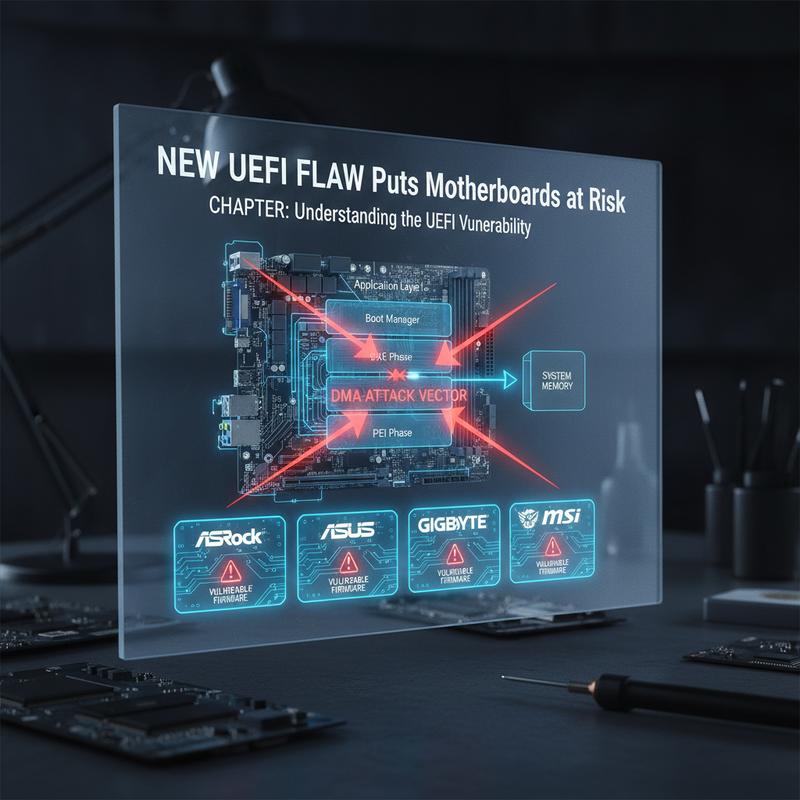
In recent years, the Unified Extensible Firmware Interface (UEFI) has been the cornerstone of modern computer architecture, functioning as the vital bridge between the operating system and firmware. However, its integral role has not made it immune to vulnerabilities. A newly discovered flaw in the UEFI presents a significant security risk, specifically for motherboards manufactured by industry giants like ASRock, ASUS, GIGABYTE, and MSI. This flaw paves the way for early-boot Direct Memory Access (DMA) attacks, a concern that reverberates across tech landscapes.
What is the UEFI Vulnerability?
The UEFI is supposed to act as a security boundary. Its primary function is to ensure that only trusted software can boot during the start-up sequence. Yet, the identified loophole compromises this foundational trust. The issue allows malicious agents to execute DMA attacks very early in the boot process, potentially bypassing all subsequent security measures.
DMA is a mechanism that allows hardware components to access main system memory independently of the CPU, facilitating faster data processing. However, in the context of this vulnerability, DMA becomes a conduit for malicious code to access and manipulate system memory directly.
The Impact on Popular Motherboards
Affected manufacturers—ASRock, ASUS, GIGABYTE, and MSI—dominate the motherboard market. Consequently, their vast customer base is exposed to this emerging threat. This vulnerability not only endangers individual users but also poses substantial risks for organizations relying on compromised systems. The flaw opens potential backdoors for attackers to install rootkits or other forms of malware that can be nearly impossible to detect and remove through conventional means.
Early-Boot DMA Attacks in Focus
Traditional security measures employed by operating systems primarily activate after boot-up. Early-boot DMA attacks occur before these defenses are operational. This timing enables attackers to inject malicious payloads that execute with elevated privileges, sidestepping OS-level security protocols. These attacks can lead to unauthorized access, data theft, and complete system compromise.
Responding to the Threat
Current mitigation strategies involve firmware updates and hardware-level adjustments to tighten DMA controls. OEMs must collaborate closely with security researchers to develop robust solutions that close these gaps. Meanwhile, users are urged to immediately apply any available patches from their motherboard manufacturers.
ASRock, ASUS, GIGABYTE, and MSI are actively working on updates, hoping to contain the issue before it becomes a widespread exploit. In the meantime, users should consider limiting peripheral device connections that might be potential access points for unauthorized DMA.
How Early-Boot DMA Attacks Are Shaping User Experience and Security

In recent developments, a startling UEFI firmware flaw has emerged, impacting a broad spectrum of motherboards from major manufacturers including ASRock, ASUS, GIGABYTE, and MSI. For tech enthusiasts and everyday users, this revelation underscores a growing cybersecurity concern: the susceptibility to early-boot Direct Memory Access (DMA) attacks.
These vulnerabilities in seemingly secure hardware infrastructures pose significant risks, particularly as they allow unauthorized access to the system’s memory during the boot process. This scenario is alarming for users who might unknowingly fall victim to potential data breaches, identity theft, or unauthorized system manipulation.
The Impact on Tech Enthusiasts
For tech enthusiasts, who often engage with custom builds and performance optimizations, the UEFI flaw is both a technical challenge and a call to action. Many pride themselves on the security and efficiency of their custom setups, and such a vulnerability necessitates a reevaluation of their approach to security. As these users are typically at the forefront of technology trends, they are now tasked with keeping abreast of firmware updates and potential patches released by motherboard manufacturers.
Moreover, these early adopters and tech hobbyists might explore community-driven solutions or workarounds as immediate fixes while waiting for official updates. Engaging in forums and tech communities, they exchange insights on how best to tackle this vulnerability, emphasizing collaborative problem-solving in the face of security threats.
Consequences for Regular Users
For regular users, who rely heavily on their systems for daily activities without delving into its underlying technology, the implications are more concerning. These individuals may not have the technical expertise to recognize if their system has been compromised or to remedy such vulnerabilities on their own.
There is a pressing need for awareness and education among average users. Security experts often recommend keeping systems updated as a basic security measure. However, with DMA attacks exploiting vulnerabilities during the boot process—often invisible to typical software updates—users must now look to firmware updates specifically. This is where support from manufacturers becomes crucial. Clear communication regarding updates and security patches can empower users to take necessary steps to protect their systems.
Bridging the Knowledge Gap
Addressing these issues requires a concerted effort from both the tech industry and its consumers. Manufacturers like ASRock, ASUS, GIGABYTE, and MSI have a pivotal role in disseminating knowledge about these vulnerabilities and providing timely firmware updates. Additionally, educational resources tailored to different levels of user proficiency can help bridge the knowledge gap, ensuring users who are less savvy can still protect themselves effectively.
For those interested in gaining a deeper understanding of data protection and system security, platforms like IT Carolina offer a wealth of resources. These include articles, guides, and community discussions that can help users make informed decisions about safeguarding their technology.
In conclusion, as the tech landscape continues to evolve, the responsibility of security becomes a shared one. By fostering an informed community, tech enthusiasts and regular users alike can better navigate and mitigate the risks posed by emerging threats like early-boot DMA attacks.
Fortifying Against UEFI Threats: Essential Protective Measures

In the wake of recently uncovered vulnerabilities in UEFI firmware affecting major motherboard manufacturers like ASRock, ASUS, GIGABYTE, and MSI, the tech community is urgently assessing the defensive strategies necessary to mitigate early-boot Direct Memory Access (DMA) attacks. These firmware flaws could potentially give attackers unprecedented access to a system during its most vulnerable phase—boot-up.
Understanding the UEFI Vulnerability
To effectively guard against these threats, it’s crucial to understand how they operate. UEFI, standing for Unified Extensible Firmware Interface, serves as a bridge between the motherboard firmware and the operating system. The flaw presents an opportunity for malicious actors to exploit this bridge, inserting code during the boot process that traditional security measures might miss.
Implementing Immediate Countermeasures
The first line of defense is keeping your UEFI firmware up to date. Manufacturers are actively releasing patches to counter these vulnerabilities, making it essential for users to apply these updates as soon as they become available—a process which can often be facilitated by a quick visit to the motherboard manufacturer’s support page.
In addition to keeping firmware up to date, enabling security features like Secure Boot can significantly bolster defenses. Secure Boot is designed to prevent untrusted firmware from loading during the boot process, thereby mitigating many types of early-boot attacks. Users should verify that Secure Boot is activated in the UEFI/BIOS settings of their systems.
Leveraging Advanced Security Solutions
Advanced Endpoint Protection solutions provide another layer of protection by continuously monitoring systems for abnormal behavior that could signal an early-boot attack. These solutions utilize machine learning and heuristics to enhance detection capabilities beyond traditional antivirus programs.
Moreover, organizations are encouraged to adopt a Zero Trust architecture, which operates under the assumption that threats could exist both outside and within the network perimeter. Zero Trust minimizes risk by continuously validating user identity and device integrity, a crucial step in securing vulnerable system entry points.
Educating and Training Users
Security is not just about technology; it’s about people. Awareness and education are critical components. Training users to recognize the signs of a potentially compromised system and encouraging regular audits of UEFI settings can help in early detection and prevention of security breaches.
The Importance of Regular Audits
Regular audits of UEFI configurations should become a staple in organizational security protocols. These audits ensure that security features are consistently applied and that no unauthorized changes have been made to system settings. Auto-remediation tools can be employed to revert unauthorized changes, maintaining system integrity.
Exploring Future Security Enhancements
The challenge doesn’t end with existing measures. As threats evolve, so should countermeasures. Companies are exploring the integration of AI to predict and react to new threats in real time, creating a dynamic security environment that adapts to potential vulnerabilities before they can be exploited.
For those interested in understanding more about cutting-edge security practices and tools available to bolster defenses against UEFI vulnerabilities, resources and further readings can be found on tech industry sites like ITCarolina.
In conclusion, while UEFI vulnerabilities present a significant challenge, a comprehensive strategy that includes firmware updates, security feature activation, endpoint protection, user education, and continuous auditing can effectively mitigate potential risks. Staying informed and adaptable remains key in the ongoing battle against cyber threats.
Final thoughts
As the digital landscape evolves, new vulnerabilities such as the UEFI flaw present serious threats to both general and advanced users. Recognizing and addressing these risks is essential to maintaining secure computing environments. By keeping systems updated and employing robust security practices, users can mitigate potential attacks and protect their information against emerging threats. Staying informed and proactive remains the key to leveraging technology safely and effectively.
Source: https://thehackernews.com/2025/12/new-uefi-flaw-enables-early-boot-dma.html